
August 14, 2026
How to Ask for a Scholarship Recommendation Letter
TL;DR. Ask three to four weeks before the deadline, and ask whether they can write you a strong letter — not just a letter. Then hand over a short packet: the award's name and link, what the letter has to cover, the deadline, exactly how it gets submitted, and two or three specifics they can point to.
Who should you ask for a scholarship recommendation letter?
Ask someone who has watched you do real work, recently enough to remember it, and who can name a specific thing you did. That's the whole test. A well-known name who barely knows you writes a vaguer letter than the teacher who read your lab reports all year.
Most providers also tell you who counts. The Corey G. Ingram Memorial Scholarship — $1,000, open to New York students, closing March 15, 2027 — spells it out: it asks for two current letters of recommendation from teachers or a guidance counselor, clergy, or people other than family members who are familiar with the applicant's skills and abilities. Read that line before you ask anyone. A letter from the wrong kind of person can sink an application that was otherwise fine.
In rough order of usefulness:
A teacher in a subject that connects to the award. They can talk about how you think, not just that you showed up. For a nursing or engineering award, the science teacher beats the one who likes you most.
Your school counselor. Best for anything about your whole record — course load, circumstances, how you handled a hard year. Counselors write a lot of these, so ask early; you are not their only student.
A coach, supervisor, or activity leader. Strong when the award cares about service, leadership, or persistence, and they have seen you do it weekly for a year.
Clergy or a community leader, where the provider allows it — the Ingram award above explicitly does.
Family is usually out. Plenty of providers exclude relatives outright, and reviewers discount the ones that slip through. If a parent genuinely supervised you in a job, ask the provider first rather than assuming.
How far in advance should you ask?
Three to four weeks before the deadline is the working minimum, and more is better in the fall, when every senior is asking the same five teachers at once. The UC Davis financial aid office and ACT both put the request weeks ahead of the due date, not days.
Work backwards from the real deadline instead of guessing:
The provider's deadline. The actual, published one.
Minus a few days of buffer, because portals go down and people get sick.
That's your recommender's deadline — tell them this date, not the provider's.
Minus three to four weeks. That's your ask-by date.
Plus one nudge, scheduled a week before their date.
Track the ask-by date, not the deadline. The deadline is the day it's already too late to start. If you keep saved awards and their dates in one place — a ScholiBuddy profile does this, and so does a spreadsheet you actually maintain — put the ask-by date in as its own entry.
Long deadlines aren't a reason to wait. Two of the awards below don't close until June 2027. You still ask now, while the teacher who just had you in class remembers what your work looked like.
What do you actually send your recommender?
Everything they would otherwise have to go find. A good packet takes you fifteen minutes and saves them an hour, and the letter comes back specific instead of generic.
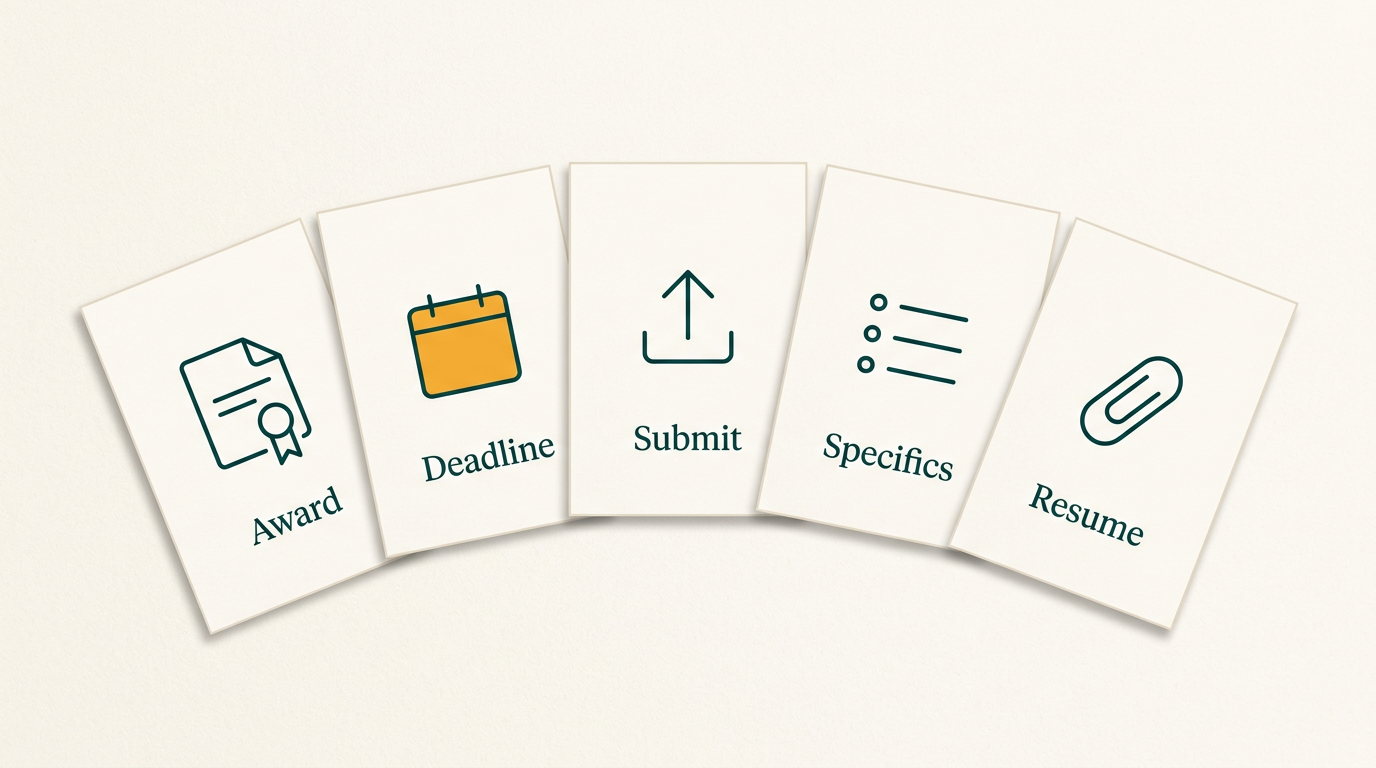
Send, in one message:
The award's name and link, so they can see who's reading it.
What the letter has to cover — some providers ask for character, some for academic promise, some for financial circumstances. Quote the requirement rather than paraphrasing it.
Their deadline (your buffered one) and exactly how it gets submitted — a portal invite, an email address, or a sealed envelope. This is the single most common place the process breaks.
Two or three specifics they can point to. The project, the semester you turned it around, the thing you organized. Not a list of adjectives — a list of moments.
Your resume or personal statement, if you have one. If you don't, a short paragraph on where you're headed does the same job.
If you've already built an application packet — transcript, essay drafts, activity list — this is the same material. Our scholarship application checklist covers what to gather once and reuse. Keeping it in one place, in a document locker or a folder or anything consistent, is what makes the second ask take ten minutes instead of an evening.
How do you ask — and let them say no?
Ask in person if you can, then follow up in writing the same day. The in-person part is what gets you an honest answer; the email is what gets you a letter.
The question to ask is "do you feel you know my work well enough to write a strong letter?" — not "will you write me a letter?" The first one gives them a graceful exit. Take it seriously if they use it: a lukewarm letter from someone who felt cornered does more damage than a warm one from a less impressive title.
A workable email, after the conversation:
Hi Ms. Alvarez — thanks for saying yes earlier. I'm applying for the [award name], which asks for two letters from teachers or counselors. It's due to them on March 15; could you have yours in by March 8 so there's buffer? You'll get a portal invite from them at your school address — it's one upload, no login. If it helps, the two things I'd point to are the water-quality project I ran in the spring and the fact that I retook the unit test after failing it. I've attached my resume and the award's description. Thank you — genuinely.
Short, dated, specific, and it tells them exactly what the submission looks like.
Can one set of letters cover more than one scholarship?
Often, yes — and checking this before you ask a fifth person is the single biggest time-saver in the whole process.
Many providers run one general application that feeds many named awards. Two real examples from the same foundation: the Carolyn Williford Murphy Memorial Scholarship and the George T. and Millicent C. Fleming Memorial Scholarship are both awarded through the Chipola College Foundation's General Scholarship Application, both close June 11, 2027, and both require the same thing: two letters of recommendation and a high-school transcript. One application. One pair of letters. Two awards considered.
So before you ask again, check three things:
Do these awards share an application or portal? If they do, you're done — one set covers all of them.
Will your recommender adapt one base letter? Most will, if you ask once and list the awards together rather than trickling requests over six weeks.
Does the provider require the letter addressed to them specifically? Some do. That's a real constraint, not a formality.
The honest limit: a letter written for a nursing award won't fit an engineering one. Reuse the letter across awards that ask for the same qualities, not across your whole list. If you're browsing awards closing soon, group them by what they ask for before you start asking people.
What if your recommender doesn't send it?
Assume nothing and verify. Most portals show you whether the letter has landed; if yours doesn't, ask the provider how to check. Silence is not confirmation.
Send one polite nudge a week before their date. "Just checking the portal link worked — no rush if it's in hand." That's it. One.
Have a backup identified from day one. Not asked, just identified. If the letter isn't in three days out, you have somewhere to go.
If a deadline passes, it passes. It's a bad afternoon, not the end of the process — there are always more awards open, and the full listings don't run out.
Never write the letter yourself for someone to sign. Providers verify, and it's straightforward fraud. It's also a signal to watch for from the other direction: any "scholarship service" offering to supply recommendation letters is running the pattern the FTC describes in its scholarship-scam guidance.
What to do after the letter goes in
Thank them in writing, and be specific about what you asked them to do — it takes two minutes and it's why the second ask goes easily.
Then tell them the outcome either way. Most students only come back with good news, so the ones who come back regardless are the ones teachers remember. And save what you sent: the packet, the award description, the version of your resume you attached. Next cycle, the whole ask is a copy-paste and a conversation.
Frequently asked questions
How many letters of recommendation do scholarships usually ask for?
Commonly two, though it varies by provider and plenty of awards ask for none at all. All three awards cited in this post ask for two. Read each award's own requirement — the number, and who it can come from, are set by the provider, not by a general rule.
Can a family member write my scholarship recommendation letter?
Usually not. Many providers exclude relatives explicitly — the Corey G. Ingram Memorial Scholarship, for instance, asks for letters from "persons other than family members." Where the rules are silent, reviewers still tend to discount them. Ask the provider before you spend the letter.
Should I write the letter myself and have them sign it?
No. It misrepresents who wrote it, providers do verify, and being caught costs you the award and the relationship. Giving your recommender specifics and a draft of your own statement is the legitimate version of that instinct.
What's the difference between a college recommendation letter and a scholarship one?
Audience and emphasis. A college letter argues you'll succeed at that school. A scholarship letter argues you fit what this specific award exists to support — service, a field of study, a community, or a set of circumstances. Same recommender, different framing, so tell them which one they're writing.
How long should a scholarship recommendation letter be?
Most providers don't specify, and it isn't your call to make. Your job is to give your recommender enough concrete material that length takes care of itself. If the award does state a limit, pass that along in your first message.
What if I'm out of school and don't have teachers to ask?
Ask a supervisor, a professor from your most recent coursework, a volunteer coordinator, or anyone who has supervised your work. If you're returning to school after time away, awards aimed at adult learners are used to seeing work references instead of teacher ones.
ScholiBuddy helps you find and apply to scholarships. We don't guarantee you'll be awarded any scholarship or any specific amount — awards are decided by each scholarship's provider. ScholiBuddy is an independent tool and is not affiliated with, or endorsed by, any government agency or official financial-aid program. Federal aid information comes from Federal Student Aid and the CFPB's paying-for-college resources.
Still searching for scholarships manually?
Find scholarships you actually qualify for — AI matches you in minutes. Free to start.
Find My Scholarships →